Town House Mill
The growth in hand loom weaving increased the need for wool processing so the now demolished mill probably started life as a water powered Fulling mill (or even a corn mill). Build date is uncertain but the date stone built into the present Town House Warehouse – LNS 1732 (some read it as 1752) may have come from the mill. The mill possibly expanded into spinning wool for hand loom weavers. In 1827 steam was introduced to a 4 storey mill at town house (likely to refer to this mill to rather than the later Croft Head Mill. The actual Town House Mill had been demolished by 1890.
Town House Warehouse (pictured below right behind the trees) was built mid-18th C in front of the mill and started as an unheated two storey warehouse with a tacking-in door on the top floor (now a smaller window). In the early 19th C, a larger 3 storey warehouse was built on the right hand end and later the original two storey structure was increased to 3 storeys. Later still, stables were added on the east end and a Cottage built on the western end.


Around 1990 Townhouse Warehouse was reviewed as a Building at Risk during which it was found to be “in poor condition, not sufficiently weatherproofed and deteriorating significantly in places, Windows not sealed and doors at all levels in poor condition. Cottage chimney stack and stack on Mill (ie Warehouse) look dangerous”. The review also found side buildings in poor condition but the rear of the building was in better condition.
In 1992 the Royal Commission on the Historic Monuments of England produced a report on Town House Mill which noted that it was not a mill, that was to the rear of the property, and that it was built in varying stages during the 18th and 19th Centuries. A further Building at Risk review in March 1994 found that the buildings had suffered further deterioration with scaffolding in place for support. It also noted that work was in hand to restore the property by its owner. The property was subsequently converted into 3 individual properties (or 4 including the Cottage on the left hand end).
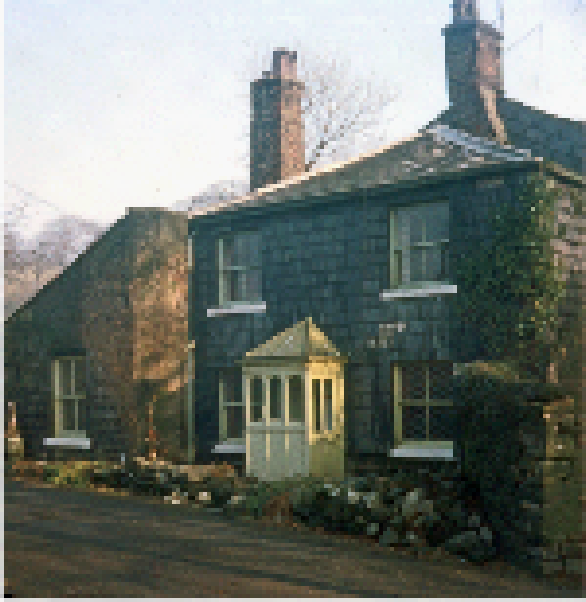
In the mid-19th Century, Town House Cottage was built on the left hand end of the warehouse with its frontage looking west. It later became known as Bowden’s House. It is pictured left as it looked circa 1960/70. In 2020 the cottage is almost hidden by surrounding vegetation. In the 2020s the cottage was refurbished and is now behind high fencing and gates so is largely hidden from view.
Town House Farm and farming has no doubt been part of Town House from early days and the farmhouse may have been the main house until the family grew in size and stature when separate houses were provided. It too has been bought and refurbished etc.
Circa 1850 some mining occurred at the bottom of Town House Wood, which probably lasted for just a few years.
Next page TOP