Ebor Engineering and early developments on Ebor Street
Ebor Engineering was located on Ebor Street adjacent to the railway embankment just north of the viaduct. The site was restricted by the River Roch which runs on the western side. It has been said that Ebor Street was named as such because of the connection to the Blackstone Edge Turnpike which would ultimately connect to York (Roman Eboracum).. Whatever, the 1850 OS map https://maps.nls.uk/view/266663665 showed a structure adjacent to the river and the turnpike but it wasn’t named or what was used for. The location was later a shop but the structures were removed some years ago and Ebor Street was brought closer to the foot of the railway embankment. The 1973 Trade Directory (TD) included William Greenwood and his Albion Foundry on Ebor St. The Littleborough Local Board passed plans for a Workshop in Ebor St for William Greenwood in April 1875. Whether it was an extension or not is unclear but William appears again in the 1890 TD but in this version the foundry was called Albert, perhaps a name change or misprint in one or the other entries. Meanwhile, in 1876 plans were approved for erection of Engine and Boiler House, Warehouse and Chimney etc for G Townsend, Ebor St. Whether a change to the 1875 approval or a modification is unclear. The TD dated 1879 included Edmund Taylor, Builder and Joiner on Ebor St. Together with William Austin, Engineer and Millwright. Additionally, it also included two companies connected to a man called Butterworth, a Cotton Spinner at Ebor Mill and Ebor Street. Other than being on Ebor Street, it is unclear which building any of these companies occupied so the age of the existing building and its original iis also unknown.
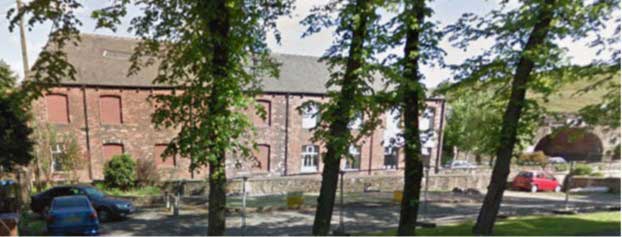
(Left)An early building on Edor St as seen from Todmorden Road (Street View April 2012)
April 1879 saw the Engineering and Millwrighting business & Plant of William Hurst, Ebor St., under auction. It was acquired by to E Taylor Builder Littleborough for £1,250 founded E Taylor & Co. In November 1879 the estate of William Austin, a wheelwright at Ebor Ironworks was liquidated albeit his name featured in a 1879 Trade directory
The Society’s Archive includes a lettr from a Mr Sutcliffe in which be lists the people involved in the development of Ebor Engineering, possibly, he thought in the early 1870’s but the summary of early companies suggest a later date. However, one of the founders was an Edward Taylor already mentioned, his brother James Taylor, who was in business as an Ironmonger. Additionally, there was a James Law from Todmorden and another Mr Law fro Sowerby Bridge (no relation). It was James Law who was in active management, the others being Directors. The Taylor family remained involved in Ebor Engineering until 1972. Ordnance Survey Maps show a separate building at the end of Ebor St as a sawmill etc which co-incides with a TD entry in 1907 showing E Taylor and Co Ltd as Builders and Contractors, Ebor Street Saw Mills.
Returning to 19th Century developments, in April 1893, the now closed Methodical Piazza alongside of the viaduct on the opposite side of the main road was occupied by Ebor Engineering. Trade Directories in 1912 and 1916 confirm Ebor Engineering as Engineers on Ebor Street.
In 1928/9 Ebor Engineering made the gears for and installed the new Water Turbine at Lydgate Mill owned by the Law’s. Apparently, it used too much water so the mill returned to the earlier water wheel. Over the years the sons of Messrs Law and Taylor Director became involved but from 1922 the business was managed by Mr Sutcliffe’s father. Later Mr Sutcliffe took over that role, The company made steam engines including. As mills turned tto electricity te company’s work diversified. The Company was never very large and Mr Sutcliffe estimated around 30 employees. The owners sold out in 1972 and after a couple of years Mr Sutcliffe left. 1975 saw Portakabin leave its factory operating factory on Ebor St to a new one located on Todmorden Road. Whether it occupied the premises previously occupied by Ebor Engineering or the saw mill is not clear but what was probably Ebor’s engineering shop was later used by car repair businesses and was being so used when it burned down in a fire. Within the wreckage an old overhead crane could be seen.
Pictured below - Norman, a steam engine name plate
now in the History Centre
Next page TOP